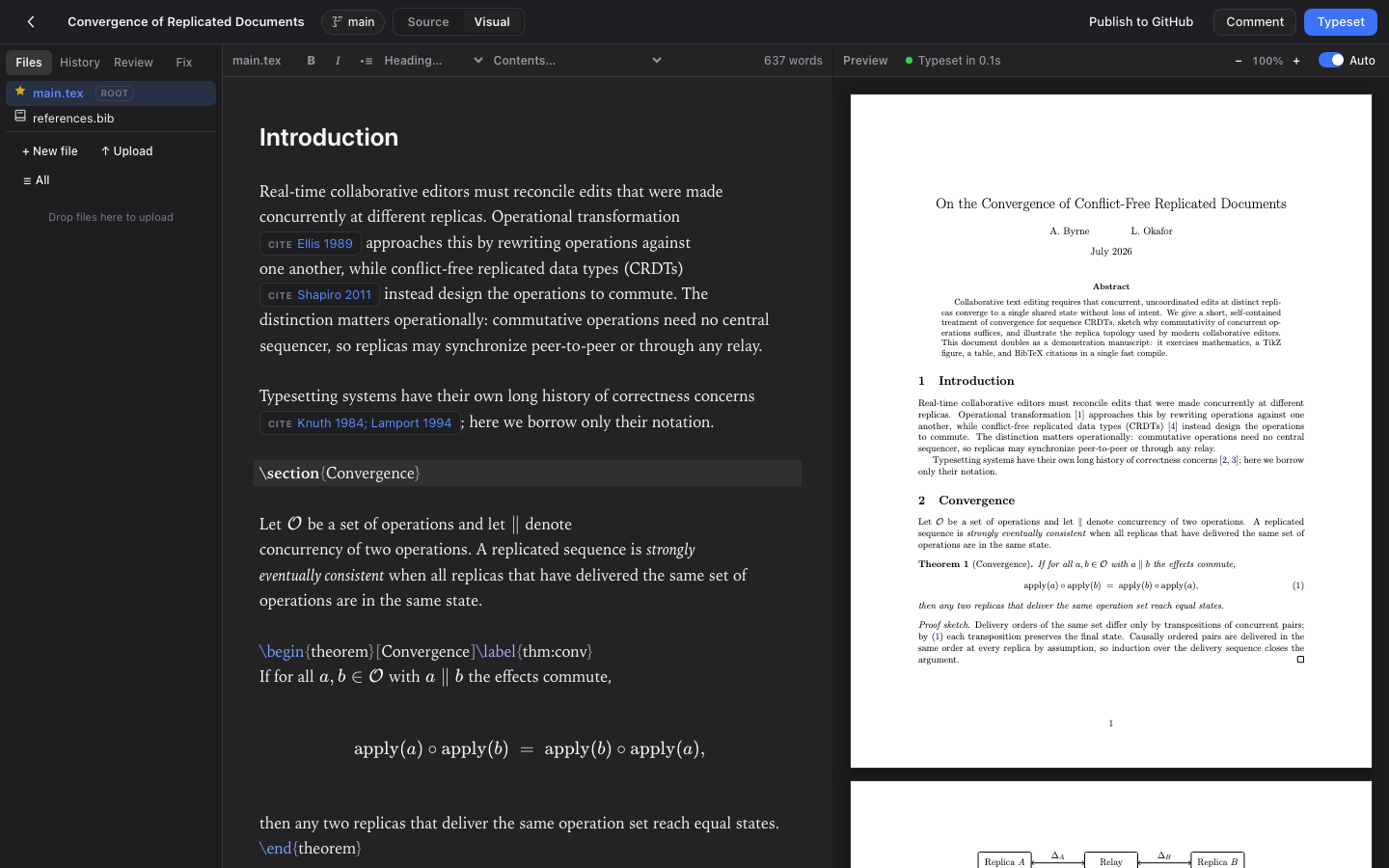
Real-time collaboration
CRDT-based (Yjs): multi-cursor, live presence,
conflict-free by construction. Unlimited
collaborators.
Git-native branches
Every project is a real git repository. Branch,
merge, and inspect history from the UI, or publish
the project and keep using VS Code.
How this differs from git with Overleaf.
Citations, solved
Zotero library sync, paper search by title
(OpenAlex), or paste a DOI: BibTeX appended and
\cite inserted in one click.
Zotero with LaTeX, three ways.
Review mode
Anchored comment threads on text selections, with
suggested replacements the author accepts in one
click.
Sandboxed compiles
TeX Live in a no-egress container: dropped
capabilities, restricted shell-escape, ~2s warm
recompiles. pgfplots, biblatex and the journal
classes out of the box; any package in one
tlmgr install line, all of CTAN one
flag away.
Self-hosting with Docker Compose.
GitHub, GitLab, Gitea and Forgejo sync
Import a repository or publish a project to a new
one, push and pull, and open a pull or merge
request from the editor. Works with GitHub,
GitLab (gitlab.com or self-hosted), Gitea and
Forgejo, Codeberg included.
Bring your Overleaf projects
Download any Overleaf project as a ZIP and drop it
on the home screen: root file detected, first
typeset automatic.
Made for real papers
SyncTeX both ways, whole-document word count,
plain-English compile errors that jump to the
offending line, one-click PDF download. Optional AI
error diagnosis with your own key, or leave it
100% AI-free.
Your files stay yours
Projects are plain .tex files in plain git repos on
your disk, readable without Aldine running, and
yours to take anywhere. AGPL-3.0, self-hosted,
nothing phones home. Flat files by default;
Postgres is the optional datastore.
Sign-in with your identity provider
Off by default for single use. Turn it on for
email and password, Google, GitHub, ORCID, or
your own OpenID Connect provider: Keycloak,
Authentik, Authelia, Pocket ID.
OIDC setup.
Claude as a collaborator
Connect your instance to Claude over MCP: Claude
writes into the live document, typesets, and shows
the PDF in the chat on claude.ai, Claude Desktop and
Cowork (a signed link in Claude Code and other MCP
clients). Every edit is a commit authored
“Claude”, with a review-and-revert
prompt. Optional, off by default.
See it in action or read
how the LaTeX MCP server works.